Canadians receive little hope for health care help from Carney’s first budget
Ottawa – Prime Minister Mark Carney’s first budget since being elected demonstrates a weak commitment to expanding and improving public health care and little vision to end the crisis facing millions of Canadians seeking help.
Budget 2025, introduced November 4 by Minister of Finance and National Revenue François-Philippe Champagne, makes successively deepening cuts to Health, amounting to nearly $400 million a year by the end of the decade for Health Canada, Canadian Food Inspection Agency (CFIA), Public Health Agency of Canada (PHAC), and the Patent Medicine Prices Review Board (PMPRB). This will mean the loss of thousands of public servants, essential to providing national leadership for our embattled public Medicare system.
Additionally, the federal government intends to let funding agreements with provinces and territories expire in the coming years, and there is no commitment evident to expand national universal pharmacare to the four-in-five Canadians who are not covered by current agreements with Manitoba, British Columbia, Prince Edward Island and Yukon.
The federal government will scale back health care for refugees, making these especially precarious people, many of whom are working in our health care system, even more vulnerable.
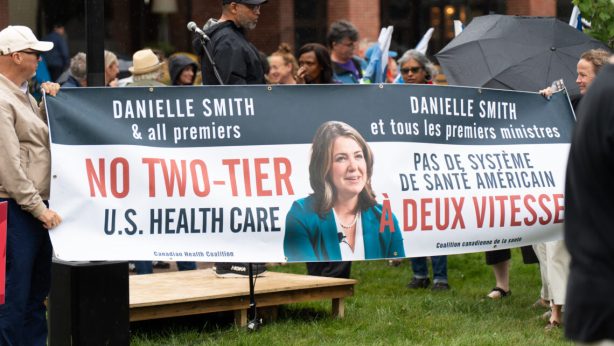
“Now is not the time to make cuts to public health care,” says Health Coalition chairperson Jason MacLean, responding to Budget 2025. “The affordability crisis is worsening, and Canadians need to know health care will be there when they need it most. This budget is void of caring for Canadians, and we demand better from our government.”
The government budget, titled “Canada Strong,” emphasizes a military build-up, natural resource extraction, and new infrastructure. The government will dedicate $5 billion over three years, starting in 2026-27, to a Health Infrastructure Fund to be used by provinces and territories to improve health infrastructure, such as hospitals, emergency rooms, urgent care centres, and medical schools.
“We need new hospitals, but we more desperately need to train health professionals to work in our severely understaffed facilities,” added MacLean. “The government should devote that $5 billion to training, recruiting and alleviating worker burnout, as well as expanding pharmacare and dental care, and provide safe long-term care.”
The Carney government is not prepared to change or cancel agreements with provinces and territories. The most significant budget line for health care – the Canada Health Transfer (CHT) to provinces and territories – will continue to grow each year as guaranteed by the previous government, but funding may not keep up with demand for health care services. Other bilateral funding agreements signed by the previous agreement will be honoured, but may not be renewed.
The budget also includes an important tax credit for personal support workers that was announced last month. This will provide $1.48 billion over six years, the majority of the funding being approved by the previous government.
The federal government is scaling back health care for refugees, making these especially precarious people, many of whom are working in our health care system, more vulnerable than they already are.
In the coming weeks and months, the Canadian Health Coalition will press Prime Minister Carney’s government to recommit to our public health care system by ending the cuts, and continuing the unfinished task of building a national, universal public health care system for everyone in Canada.