A big day for pharmacare
In a day of action for pharmacare on May 7, the Canadian Health Coalition and partners, including experts and patient advocates, organized a media conference on Parliament Hill, met with key MPs and released a video, as Bill C-64, An act respecting pharmacare, passed second reading in the Parliament.
The day began with experts and patients affected by the proposed pharmacare bill calling on parliamentarians to pass the legislation as soon as possible at a press conference in the Parliamentary Press Gallery that can be viewed on CPAC here –
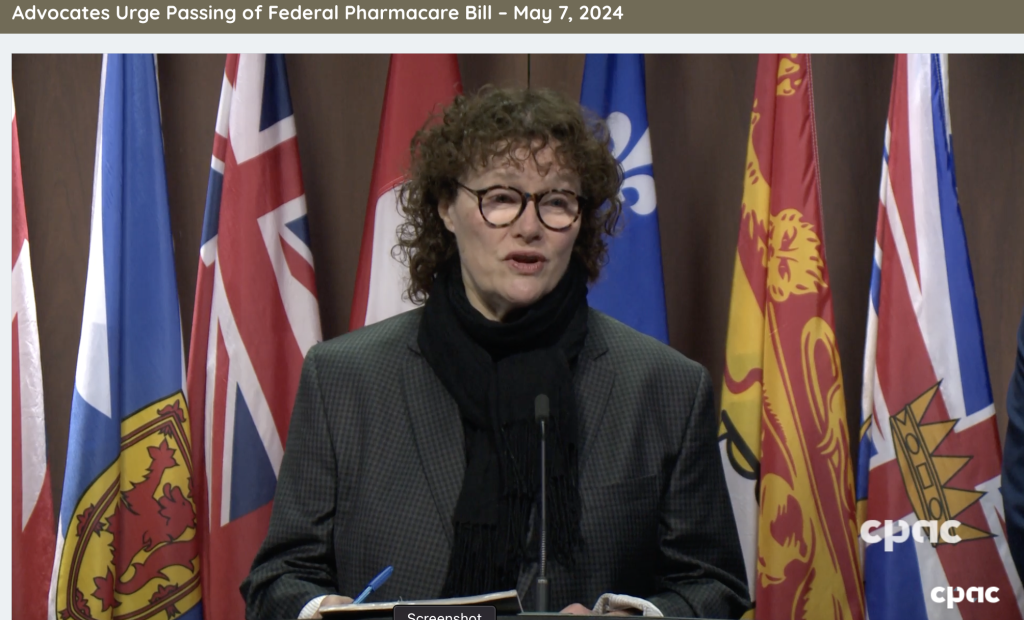
Frédérique Chabot is Acting Executive Director of Action Canada for Sexual Health and Right. Chabot told reporters, “Universal access to contraception for 9 million Canadians of reproductive age reduces gender inequality, improves health outcomes, and saves on health care costs.”

“We want provinces and territories to sign up to this transformative program. The overwhelming public support for this initiative is evident, with individuals already urging their provincial governments to take decisive action,” added Chabot.
Mike Bleskie, an uninsured precarious worker and Type 1 Diabetes advocate, said, “I was diagnosed in 2005 and have navigated the private and public drug insurance system in that time. It’s time for governments to help the 3.7 million Canadians like me living with diabetes who face hefty costs for prescription medicine and related devices.”
Steve Morgan, economist and Professor of Health Policy at the School of Population and Public Health at the University of British Columbia, joined virtually and said the next step is to expand the program to include other classes of medications.
“National pharmacare should be expanded over time to cover all medication needs, beginning with the most commonly-prescribed, clinically-important ‘essential medicines’ from a wide range of treatment categories,” said Morgan.
Following the media conference, Mike Bleskie, Action Canada’s Fréderique Chabot and the Canadian Health Coalition’s Steven Staples and Anne Lagacé Dowson met with Peter Julian, the NDP Health Critic, and MP for New Westminister-Burnaby as well as staff in the offices of Health Minister Mark Holland and Government House Leader Steven MacKinnon.

The private health insurance industry and pharmaceutical companies have long profited from the fact that Canada does not have universal coverage for prescription drugs.
Drugs in Canada are more expensive. Canada is the only country with a public health care system that does not include drugs. Meanwhile, about 1 out of 5 people in the country report not being able to afford their medicine. Low-income people, immigrants and racialized peoples are especially affected by the lack of access to medicine. These are messages heard in a video of Canadian Health Coalition members.
Pharmacare advocates agree that the pharmacare legislation on the table is a historic first step, setting a framework for a single-payer, universal system of drug coverage, but that more work needs to be done to ensure it includes more kinds of medicine.
Bill C-64 is now on its way to the Standing Committee on Health, known as HESA, where the MPs making up that committee will review, hear from witnesses, debate and possibly amend the bill.
Good news: the Pharmacare Act has passed 2nd reading & is off to #HESA.
— Canadian Labour (@CanadianLabour) May 7, 2024
This bill will enhance our health care system & put money back into the pockets of millions of workers & their families.
Now MPs must work together to get it passed quickly. #PharmacareNow https://t.co/ja0oVP2H88
Canadian Labour Congress president Bea Bruske told rabble, “We know that pharmaceutical companies will always put profit first. But why is Pierre Poilievre siding with Big Pharma against women, workers and families,” she said.
“In Canada we know over one million people struggle to be able afford the medications that they need and that’s why we need a universal single-payer pharmacare plan. Conservatives have to stop the delay tactics and their cynical attempts to block free birth control for families,” added Bruske.
The Canadian Health Coalition encourages everyone to send a letter to your MP today, asking them to support a robust pharmacare program that is single-payer, universal, and publicly delivered.
No more pill splitting. No more dose skipping. Pharmacare can’t wait.
Support the Canadian Health Coalition
Tracy Glynn is the National Director of Projects and Operations for the Canadian Health Coalition