Advocates share strategies for saving Canada’s public health care
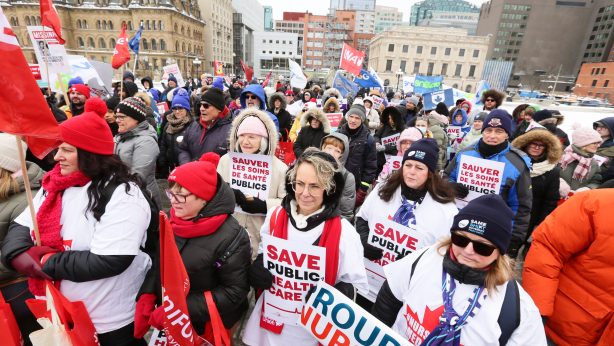
With unprecedented attacks on Canada’s public health care system, defenders of public health care in Ontario, Quebec, Alberta and B.C. shared various strategies to protect Canada’s universal public health care system in a webinar hosted by the Canadian Health Coalition’s Anne Lagacé Dowson on December 8. The webinar is now available for viewing here:
From going to court to filing complaints, mobilizing experts and local activists, public health care advocates across the country are busy leading the charge for better Medicare.
“Albertans did not vote for Danielle Smith’s massive restructuring of public health care”
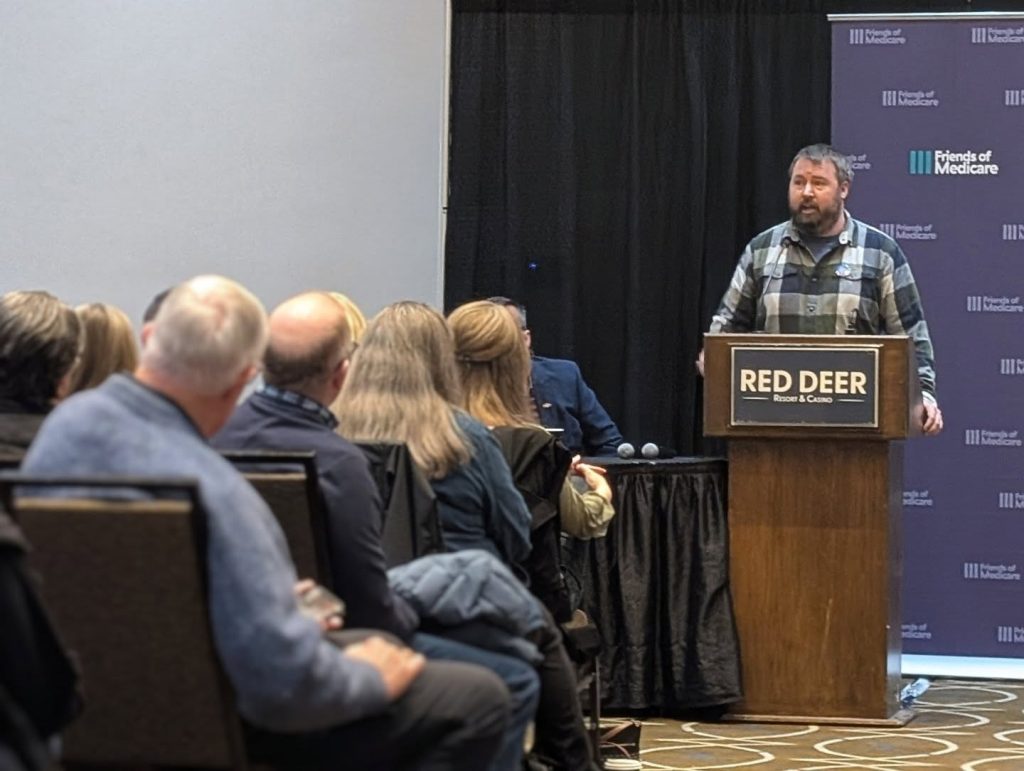
Of top concern is Bill 11, expected to pass in the Alberta Legislature this week. Chris Gallaway, Executive Director of Friends of Medicare, noted Albertans did not vote for Danielle Smith’s massive restructuring of public health care.
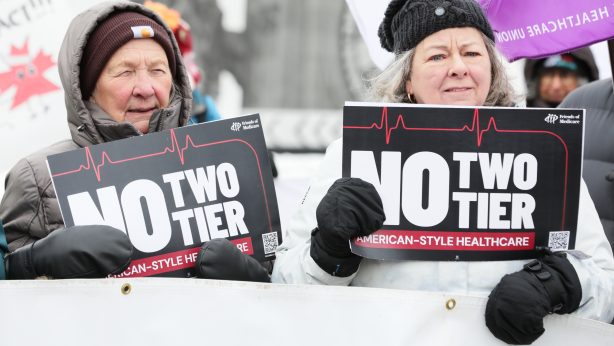
“The legislation allows for full two-tier American-style health care, where doctors will be allowed to operate within the public and private system at the exact same time, something that’s not allowed,” said Gallaway.
“Those with money will be able to pay for access, will be able to pay for short, quick access. And the rest of us will be left waiting even longer because we know that there isn’t actually enough health care human resources and workforce to have two systems in Alberta. We’re already feeling that with the privatization of surgeries,” argued Gallaway.
Friends of Medicare have launched the Rebuild Our Healthcare campaign, which includes a platform for Albertans to share their stories accessing health care.
Gallaway pointed to recent polling that shows Albertans do not support two-tier health care. “They support a universal public system, and they want a government that supports and moves forward free access, universal access, equal access. That’s what they support,” said Gallaway.
Gallaway has been on tour across the province, reaching hundreds of people with lots to stay about health care at each stop, including in government-held constituencies in rural Alberta.
“They’re violating our Medicare laws”
Natalie Mehra is the Executive Director of the Ontario Health Coalition. She explained that similar attacks on public health care are underway in Ontario. She denounced Ford’s privatization of long-term care.
“The biggest winners are the largest chains, with the worst records in the pandemic for deaths and negligence, and most of those deaths, as you know, were preventable,” said Mehra.
Pointing to the Canada Health Act, Mehra said, “We all have the right to health care based on our medical need, not how wealthy we are, that we pay ahead of time through our taxes. Health care should be available to us when we’re elderly, when we’re sick, when we’re dying, when we’re least able to pay for care.”
Mehra noted that the Ford government is allowing private clinics to charge patients for cataract surgery, for queue jumping. “They’re violating our Medicare laws,” said Mehra, adding that the elderly patients on fixed incomes are being told they can wait two years to get their surgery in the public hospital or pay $4,500 in a private clinic, when in fact, 80 per cent of patients are able to get cataract surgeries within seven weeks in the public system.
The Ontario Health Coalition has been gathering patient complaints and holding press conferences with patients who have been extra-billed in the private clinics. In June, 50 patients agreed to go public and were part of a complaint filed to the provincial and federal ministers of health.
Mehra shared other strategies of the Ontario Health Coalition including filing information requests, releasing reports, sharing patient stories, and organizing days of action at the Ontario Legislature, filling the gallery with patients and priming opposition parties to fight back. They also engage in mass leafletting and have a petition calling on the federal government to uphold the Canada Health Act in Ontario and stop the Ford government from extra-billing the patients.
De-facto two-tiered health care challenged in court
Cory Verbauwhede is a Montreal-based lawyer, professor of health care and social services law, and a co-founder and former member of the board of Médecins québécois pour le régime public (MQRP).
Verbauwhede provided some historical context to the development of a two-tiered health care system in Quebec, beginning with the Chaoulli decision, a 2005 Supreme Court of Canada ruling that struck down Quebec’s ban on private health insurance for services covered in the public system in circumstances where wait times in the public system were considered unreasonably long.
For Verbauwhede, Quebec’s delisting of diagnostic services to outside hospital settings in the 1980s “created a de facto two-tiered system in those diagnostics.”
On the topic of Quebec doctors operating outside the public system, Verbauwhede said his organization has proposed a cap on non-enrolled physicians’ private fees to stop them from charging whatever they want.
“If you cap their fees, that takes away a big incentive for them to leave the public system. We also asked for doctors to be required to choose, either be 100 per cent in or 100 per cent outside of the system. Of course, it would be better to have the Ontario system where you cannot be private,” said Verbauwhede.
Verbauwhede said MQRP is also arguing for publicly-owned ambulatory clinics “because there’s all kinds of conflicts of interest that happen when they’re privately owned, even if they’re publicly paid.”
Verbauwhede moved on to talking about class-action lawsuits launched in Quebec that targeted doctors and clinics for illegally charging patients extra fees for insured medical services, including for medications.
“We won because the evidence and the people were on our side”
Ayendri Riddell is the director of policy and campaigns of the British Columbia Health Coalition. She discussed the organizing that occurred in the province of British Columbia to stop doctors from being allowed to charge for medically necessary services.
Riddell explained that in 2006 and 2007, there were accusations that surfaced of private surgical clinics openly defying the Canada Health Act by billing patients directly for services while also billing the public system. The BC Nurses’ Union was instrumental in gathering the complaints and supporting the patients taking their complaints to BC’s Medical Services Commission, a body that investigates violations such as extra-billing and user charges. The Commission notified the clinics that were subject of the complaints that they would be audited.
With the support of the BC Nurses’ Union, the complainants filed a petition for the Medical Services Commission to enforce the province’s Medicare Protection Act and stop the out-of-pocket payment for services that should be in the public system. While the audit revealed double billing and patients being charged for medically necessary services, the practices continued and CEO doctors responded with an unsuccessful charter challenge.
Dr. Brian Day and Cambie Surgeries tried to challenged B.C’s ban on private billing of medically necessary services by arguing it violated Charter rights to life-security due long public wait times. The Supreme Court of Canada dismissed the final appeal in 2023, ending the decade-long legal battle. The courts found that private care would worsen public access.
Riddell highlighted the BC Health Coalition’s interventions in the Cambie case and the extensive organizing to gather evidence. “We won because the evidence and the people were on our side,” said Riddell.