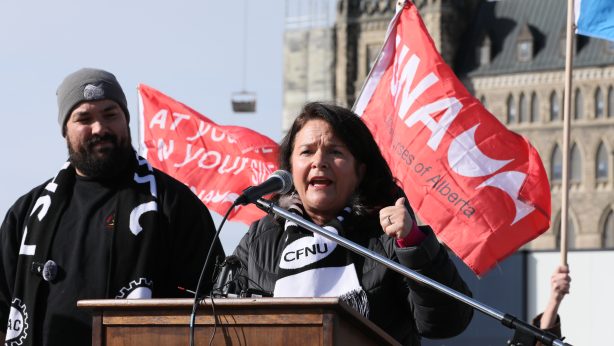
“Health care is a human right, not a subscription service,” says Manitoba international student leader
A new report finds some provinces and territories treating international students like tourists and calls for their equal access to public health care.
International students in Manitoba, Ontario and the Yukon must pay private insurers for health care while international students in other provinces and territories have different kinds of access to public health care.
The report, Free and Universal? Disparities in International Student Health Care in Canada, authored by the Canadian Health Coalition’s Tracy Glynn and published on January 29 by the Canadian Health Coalition and the Madhu Verma Migrant Justice Centre, calls for provincial/territorial governments to grant Medicare on arrival to international students. It notes that Manitoba, Ontario and the Yukon are particularly failing international students by shutting them out of Medicare during their studies.
The report was launched at a webinar that is now available for viewing here:
Hafiz Jatto was an international student at the University of Manitoba from 2015 to 2021. He has worked on migrant rights projects and coordinated community-based research on international student health in Manitoba. He shared the limitations of the Manitoba International Student Health Plan (MISHP). The MIHSP is the private primary health insurance for many international students in Manitoba. It costs about $1,200/year.
“The MISHP is supposed to give international students access to the health care they need, to focus on studies, but the lived experience of the students shows that is not the case, while they may have MISHP coverage, they are not able to focus on their studies for a number of reasons such as the coverage not being comprehensive, not universal and is not equitable to the universal primary health care coverage we know Canada for,” said Jatto.
Alan Saji Koshy is an international student and President of the University of Winnipeg Students’ Association. He shared, “While Manitoba recently made headlines for providing free contraceptives and diabetes medications, international students are excluded because we lack a provincial health card.”
“We’re essentially living in a province that offers universal benefits, that international students contribute to through tuition, labour and taxes but are barred from accessing. Health care is a human right, not a subscription service. We’re not asking for a gift, we’re asking for the restoration of a right that was taken away,” said Koshy.
“International students are not temporary people. We are community members, researchers, we are neighbours. Let’s take the question mark out of the title of this report. Let’s make health care truly free and truly universal,” added Koshy.
Omega Budhathoki is Vice-President of External Affairs of the University of Winnipeg Students’ Association. She has led student campaigns for mental health access and equity, and has worked with community organizations across Winnipeg.
“At one point, in the province of Manitoba, health care coverage for international students was a pride but was taken away in 2018, the reason being the province would save $3.1 million. To put that in perspective, it is a fraction of barely 0.05 per cent of the provincial health budget for that year. The province spends $3.1 billion in less than a day on health care,” said Budhathoki.
“For thousands of international students, this decision has changed everything, that number has become the price of our safety, our dignity, our peace of mind and a number that represents 0.0 per cent of the provincial health budget is 100 per cent of our security. That small number has translated into a very big consequence of fear, isolation and uncertainty for folks who came here with hope to study, to work, to contribute to the life of this province and country every single day,” added Budhathoki.
Lutfunnessa Tania is a graduate student from Bangladesh studying in the Migration and Diaspora Studies program at Carleton University. She is currently doing a placement on migrant health care with the Canadian Health Coalition and Madhu Verma Migrant Justice Centre. She is also a parent of a young child.
“I often find that in practice, we do not have equal access, equal affordability as OHIP, and we do not have proper information on where to go, what to do in case anything happens and finding a family doctor has been really difficult. And when we do not have any guarantee to find a family doctor, we often go to a walk-in clinic or rely on Shoppers Drug medicines. And most of all, the constant emotional burden of calculating whether this health issue is risky enough to go visit a doctor, or go visit emergency is extra stressful,” said Tania.
“Also, as a parent, I believe health care is a very basic human right, and] there shouldn’t be any disparity between a Canadian citizen or between the international student based on their immigration status, based on their tuition fees and how much they pay and how much do they get in terms of what they pay,” added Tania.
Noah Schulz, the Provincial Coordinator of the Manitoba Health Coalition, is hopeful that the Manitoba government will restore access to public health care for international students.
“We also have a window of opportunity with this government. There is a mandate letter to the Minister of Higher Education to restore this program. This was a government commitment they made and promised on the campaign trail, and now they are in power,” said Schulz.
“These students are already here. They’re already accessing the health care system and putting more strain on it because they are making these life-or-death or ‘can I afford to be sick?’ kinds of questions, and so it leads to students putting off treatment, putting off prevention, and not getting well as soon as they could, never mind the emotional and mental health strain,” said Shulz.
“We want to see health care as a right not a commodity,” added Schulz.
Divine Bright and Samantha Ho are Carleton University health science students doing a placement with Citizens for Public Justice and the Canadian Health Coalition.