
“Health care is on the boss,” finds study on migrant workers in Nova Scotia
Today, my research team released our latest report on the working conditions of temporary foreign workers in the Maritimes.
The report, “Falling Short: Troubles with the Seasonal Agricultural Worker Program in Nova Scotia,” is by Raluca Bejan, Kristi Allain, Paola Soto Flores and myself, and is published by the Migrant Workers in the Canadian Maritimes research and knowledge dissemination platform, and the Canadian Centre for Policy Alternatives – Nova Scotia. The report can be read online here.
Drawing on desk research and interviews conducted with 15 temporary foreign workers between September 2020 and June 2023, the report maps the working and housing conditions of temporary foreign workers in Nova Scotia during COVID-19 and makes a series of policy recommendations to protect the rights of migrant workers.
We found health care is one of the serious issues of concern for migrant workers. Our policy solution is to provide access to public health care to all temporary foreign workers upon arrival in Canada.
Nova Scotia’s seasonal migrant workers are shut out of public health care if they do not meet residency requirements.
To quality for public health care in Nova Scotia, temporary foreign workers must hold a work permit or employment contract that is valid for a minimum of 12 months but many of them work on shorter contracts. The Canadian government requires that employers of temporary foreign workers provide private health insurance to workers who do not have public health insurance. However, private insurance often forces low-wage migrant workers to pay up-front for health care and then wait for reimbursement, something that many are not able to afford.
Our study noted several migrant workers expressing concern their private insurance did not cover all illnesses, treatments, and medications, and that they were not given adequate information about their health care coverage.
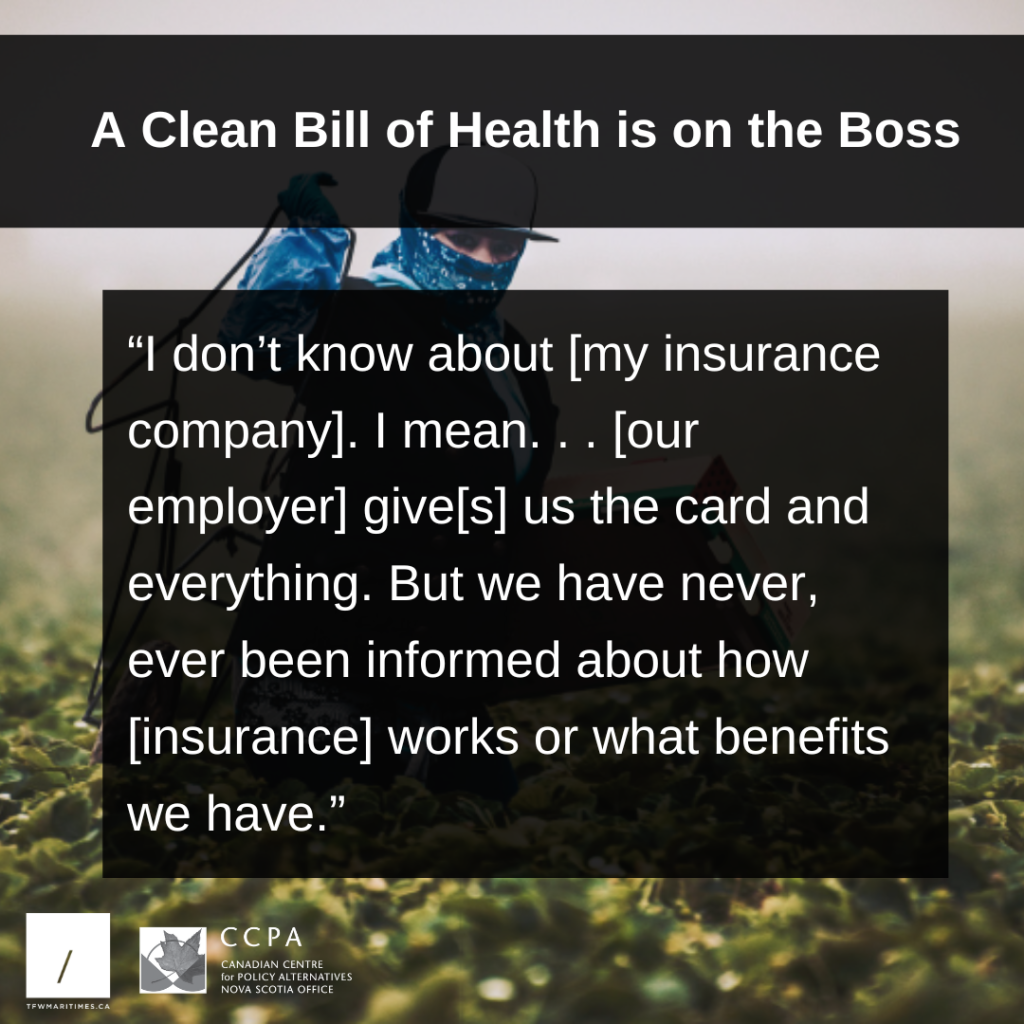
Migrant workers also told us they had to rely on their employers to access their health insurance and for transportation to health care facilities. Some said their employers delayed taking workers for medical treatment and some employers suggested workers forgo treatment altogether.
[My colleague] talked to the boss. . . or the supervisor above him. . . And they ignored him. That is, they did not pay attention to him until later, until they really saw him almost dying. That’s when he was taken care of. In the meantime, they [claimed that they]. . . “did not have time right now,” [stating], “you will have wait.”
Migrant worker
On one occasion, a housemate got sick. . . he was crying in pain. And we talked. . . to a supervisor who is above the foreman, and no one responded. We spoke to another supervisor. . . They ignored us. . . And a secretary who worked in the company. . . she was the one who told us, “You know what? Don’t be afraid to call an ambulance. The cost, the company is going to have to pay for it.” And we even called a colleague who speaks English well to call [the ambulance]. . . It came for him, but unfortunately because that colleague was scolded, they scolded us all because we had done that. . . [saying] it was a lot of money. . . They put pressure [on us not to call].
Migrant worker
Migrant workers interviewed noted they did not want to take days off even when they were ill because it meant a day with no pay. One worker commented, “We can take [time off] by reporting sick, but since the day would practically be a lost day, well, that’s why many times I don’t take it, because it doesn’t make sense.”
The Migrant Workers in the Canadian Maritimes platform is coordinated by researchers at Dalhousie University, St. Thomas University, and the Cooper Institute in Prince Edward Island, and funded by the Social Sciences and Humanities Research Council. This report was supported and reviewed by the Canadian Centre for Policy Alternatives (CCPA) Nova Scotia, the Cooper Institute and Madhu Verma Migrant Justice Centre.
Besides important findings on health care access, we found migrant workers frequently struggled with overcrowded housing, inadequate pay and safety training, and lack of health care. “Rules exist, but governments are failing to adequately enforce them to create a safe and dignified work environment for migrant workers,” notes the report.
The report outlines a series of recommendations directed at the federal and provincial governments to better improve the conditions of temporary foreign workers in Nova Scotia. These recommendations include much needed reforms to immigration, employment standards, housing, and health care.
Tracy Glynn is the National Director of Projects and Operations for the Canadian Health Coalition