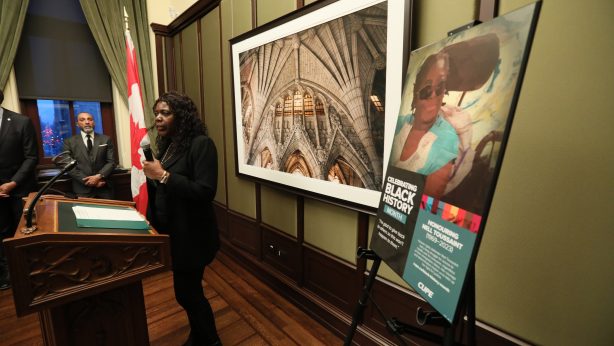
Remembering Nell Toussaint’s struggle for medicare for all, regardless of immigration status
This commentary was published by the NB Media Co-op to mark the one year anniversary of Nell Toussaint’s death.
Odds are that you have a medicare card.
Imagine, for a second, that you do not.
Imagine that you go to the emergency room. You are told that if you cannot show proof of insurance, you must pay. Your condition worsens. Now you have pre-existing illnesses that make it even more difficult to find any insurance.
For migrant workers in Canada this is no thought experiment. This is life.
For Nell Toussaint, this was death. One year ago, today.
Born in Grenada, Nell was raised in Trinidad. She moved to Canada in her twenties, and worked as a cleaner, a child care provider and a factory worker. But Canada’s immigration system is cold and complex. She became an “irregular” migrant over time – someone who falls out of immigration status for one reason or another.
Irregular migrants in Canada don’t have access to public health care.
When she became sick, she was denied access to health care. As her condition worsened, the harm she suffered became irreparable. Yet, neither her province nor the federal government would insure her.
Not one to give up, Nell Toussaint took Canada to court with the claim that denying irregular migrants access to health care violates the Canadian Charter.
She took her fight all the way to the United Nations. A UN committee ruled that Canada violated her right to life, and asked Canada to grant health care to all irregular migrants.
Canada simply refused.
Some argue Canada is right. They argue that it would be too costly to provide health care for all regardless of immigration status.
But ensuring everyone has access to health care when they need it reduces costs to the system in the long run by avoiding emergency room visits and preventable surgeries. It also reduces public health risks if everyone can access health care when they need it.
The COVID-19 pandemic pushed Ontario to cover everyone’s health care, recognizing that universal health care coverage is good public health policy. Data showed that health care for uninsured people in that province cost $6.8 million in 2020-2021. Sadly, Ontario discontinued the coverage last March.
It would undoubtedly cost New Brunswick much less. Instead, New Brunswick gave hugely profitable pulp and paper mills over $100 million in subsidies through an NB Power energy buy-back scheme over a decade.
Others argue that limiting access to health care based on immigration status would deter those who might seek to come to Canada to take advantage of the health care system.
In fact, Canada made this argument in court, claiming that Nell Toussaint was simply looking to exploit Canada’s generous public health care system. We agree with the judge in the case who responded plainly that it was a “dog whistle argument that reeks of the prejudicial stereotype that immigrants come to Canada to milk the welfare system.”
Nell did eventually get permanent residence status under humanitarian and compassionate grounds, which allowed her to finally access health care. But it was too late. The damage was already done. She had lost a leg to amputation, become blind, and suffered brain injury and kidney failure. Her death at the age of 54, on January 9, 2023, was entirely preventable.

When we received a call this year from a migrant worker in the Acadian peninsula needing to see a doctor without health insurance, our hearts sank.
New Brunswick doesn’t generally provide health care to migrant workers to begin with. Migrant workers who cannot get medicare coverage must rely on their employer for private health insurance.
This means that they are vulnerable to one of many critical flaws of privatized health care – lose your job, lose your health care.
For migrant workers, whose immigration status is tied to their employer, losing their job does not only mean losing their often-sub-par private health insurance. It can also mean losing the ability to remain in Canada. When workers stay anyway, they risk becoming irregular migrants.
Denying members of our community access to public health care simply because of their immigration status is not in the spirit of the Canada Health Act which calls for universality. It is not in the spirit of international law. And it is not in the spirit of what it means to build a truly welcoming province.
Nell fought so that nobody else would have to. She died, but nobody else has to.
Let’s learn from history so that we do not repeat it.
Aditya Rao and Tracy Glynn are founding members of the Madhu Verma Migrant Justice Centre. The Madhu Centre provides support to migrant workers and those with precarious immigration status in New Brunswick. Aditya is also a Senior Human Rights Officer at CUPE. Tracy is the National Director of Operations and Projects for the Canadian Health Coalition.