
Watch Jim Stanford and Angella MacEwen on what Trump’s tariffs mean for health care in Canada
Almost nine in ten doctors in Canada say they are concerned about the impact of Trump’s tariffs on patients in Canada, according to a survey by the Canadian Medical Association. The doctors are most concerned about the cost of living for patients (83%), the cost of medications (70%) and a potential shortage of medications (71%).
To help make sense of what the tariffs could mean for Canada’s health care system, economists Jim Stanford and Angella MacEwen joined the Canadian Health Coalition’s Anne Lagacé Dowson for an online conversation on April 7, 2025. The webinar is now available for viewing here –
Jim Stanford, economic commentator and director of the Center for Future Work, noted that the biggest non-traded industry in our economy is health care. He argued, “There are business types who are going to seize on this moment and all of the uncertainty to say, ‘we need more austerity. We need more cutbacks.’”
After explaining the implications of Trump’s tariffs, Stanford said, “Most of what we buy from America are not finished products labeled made in America that show up on the shelves at Canadian Tire. Most of what we buy from America are inputs to our economy.”
For Stanford, Canada’s response needs to be structural and not about individual consumer choices. “We need a new national policy for Canada’s economy,” said Stanford.
“We need to imagine a strategy for building Canada’s economy in a very high value, sustainable, technology-intensive way, with lots of investment including infrastructure, public programs, housing and health care, all of those non-traded industries that actually make up the big bulk of our economy,” said Stanford.
- Slideshow – Trump’s Trade War: Debunking his Lies, Tallying the Cost, Building a Response by Jim Stanford, Economist & Director, Centre for Future Work, April 2025
Angella MacEwen is a senior economist for the Canadian Union of Public Employees. She explained that some sectors like steel and aluminum are getting slammed with 25 per cent tariffs. “We will see unemployment. We will see government revenues fall,” said MacEwen while highlighting that CUPE and Unifor had released a joint statement earlier that day on protecting jobs.
MacEwen called for public investment to make Canada more self-reliant, more independent. She noted CUPE’s Montreal Declaration where on March 6, 2025, more than 500 CUPE members called for “a worker-focused response to the existential crisis posed by Donald Trump’s assault on Canadian workers.”
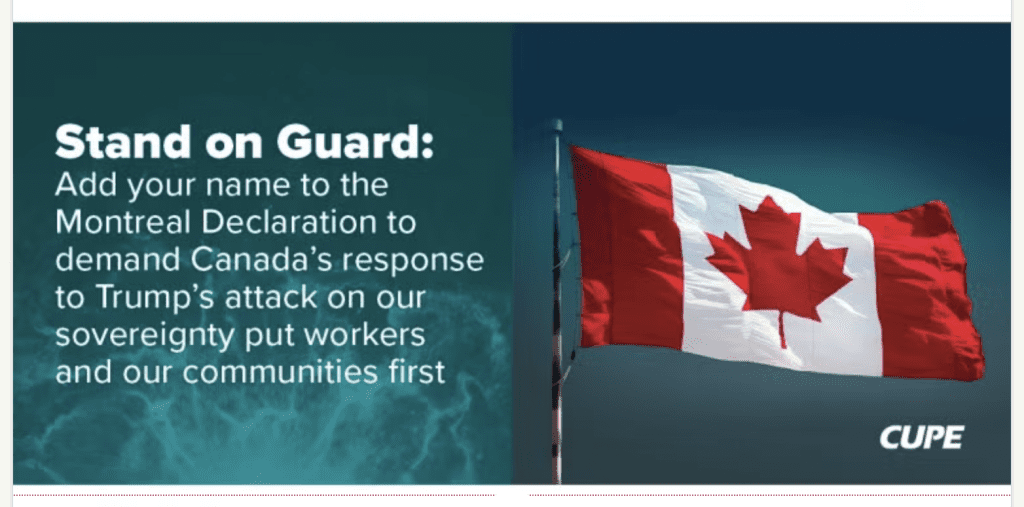
The declaration calls for more than just “buying Canadian.”
This is our opportunity to reshape the Canadian economy into something that truly works for the people. We must advance public solutions in key sectors like agriculture, transportation, infrastructure, and natural resources, and diversify markets for Canadian products beyond the United States.
We must respond to the threats against the things that make us proud to be Canadian by making them stronger – not by allowing them to be torn apart. We must reject the kneejerk calls for tax cuts, deregulation and privatization from corporate boardrooms and the right-wing.
MacEwen noted that health care system is in crisis. Education has been underfunded. She cautioned, “We expect governments to pull back on some of this spending that was already being underfunded. And that’s exactly the wrong approach.”
She called for more investments in employment in communities “that are going to keep people working, that are going to keep money circulating in those communities. And that’s in the schools, that’s in the health care, that’s in creating jobs, building new houses for people. That’s creating jobs, building publicly owned infrastructure. And the advantage with publicly owned infrastructure is that it’s built in the public interest.”
MacEwen said pharmaceuticals are one industry that has been targeted for potential tariffs. She said more needs to be done to support the production of pharmaceuticals in Canada.
“In our trade negotiations with the United States, they keep trying to extend the patent length for pharmaceuticals so that higher priced goods are on the market for longer,” said MacEwen.
MacEwen noted the ongoing problem of privatization of health care across Canada, with provinces like Alberta and Saskatchewan offering more private surgical clinics. She called it a shell game: “It’s the same surgeons, it’s the same equipment, it’s the same nurses.” She referred to how an Ottawa-based hospital was allowed to rent out its operating room on the weekends.
“What we really need to have is the courage of our convictions and to double down on what has made Canada so successful, which is the public infrastructure that we’ve built, the public services that we have, the public health care that we rely on,” added MacEwen.
Upcoming webinars –
April 10 – Maxim Fortin, chercheur, IRIS – Institut de recherche et d’informations socioéconomiques (seulement en français/only in French). Zoom link ici.
April 15 – Dr. Danielle Martin, Chair, Department of Family and Community Medicine, University of Toronto, on federal opportunities for public health care. Register for the Zoom link.
April 22 – Dr. Brandon Doucet, Chair, Coalition for Dentalcare, on dental care being an election issue. Register for the Zoom link.
April 29 – Steven Staples and Anne Lagacé Dowson, Canadian Health Coalition, on what the federal election results mean for public health care. Register for the Zoom link.
Webinars are recorded for later viewing on the Canadian Health Coalition’s youtube channel.
For more information, contact Tracy at tglynn@healthcoaliton.ca.