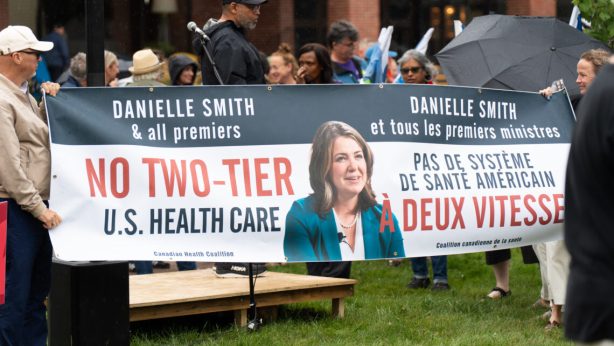
Feds rightly cautious about provincial demands for unconditional health funding
Premiers want more funding from the Federal government, demanding “sustainable” health care funding at a press conference last Friday. But it remains unclear how the Prime Minister will respond.
At their meeting in Regina, the Premiers of British Columbia, Alberta, Saskatchewan, Manitoba, Northwest Territories and Yukon focused on the annual federal transfer of health care funding through the Canada Health Transfer (CHT). The CHT is governed by the federal Canada Health Act and is set through the Federal-Provincial Fiscal Arrangements Act (FPFAA).
Premiers from across Canada have been lobbying the federal government to increase its share of health transfer to 35 percent from the current 22 percent of public health costs, which is estimated to cost an additional $28 billion annually. Previously Prime Minister Trudeau has said he will not discuss increasing health transfers until the pandemic is over.
A sticking point is whether increased CHT funding would come with conditions on how the money is spent.
“Trudeau is correct to avoid what may amount to cutting a blank cheque to provinces if he cannot ensure that the money will deliver improvements to existing public health care and expanding public health care to much needed long-term care and universal pharmacare”
PAULINE WORSFOLD AND SIOBHAN VIPOND
The Premiers want the funds to be delivered without strings attached since they view providing health care as a strictly provincial responsibility. “Federal investments must be unconditional to provide maximum flexibility to provinces and territories to invest in their unique health opportunities,” they wrote to all federal party leaders last summer.
But the Canadian Health Coalition, which supports increased federal spending on health care, urges caution.
Chairperson Pauline Worsfold, RN, and Vice-Chairperson Siobhan Vipond pointed out in the Toronto Star, “Trudeau is correct to avoid what may amount to cutting a blank cheque to provinces if he cannot ensure that the money will deliver improvements to existing public health care and expanding public health care to much needed long-term care and universal pharmacare.”
The federal government argues that it has spent $63-billion on health care during the pandemic, and it has committed an additional $2-billion to provinces to reduce wait times. More than eight out of every ten dollars provided in Canada to fight COVID-19 and support Canadians has been provided by the federal government, it says.
“The federal government wants to ensure that any additional federal funding will improve Canada’s health care system,” the Liberals said in Budget 2022. “Any conversation between the federal government and the provinces and territories will focus on delivering better health care outcomes for Canadians.”
The Premiers have invited the Prime Minister to work with them and begin negotiations for a First Ministers’ Agreement on Sustainable Health Care Funding. Their next gathering will be held in BC Premier John Horgan’s capital of Victoria in July.