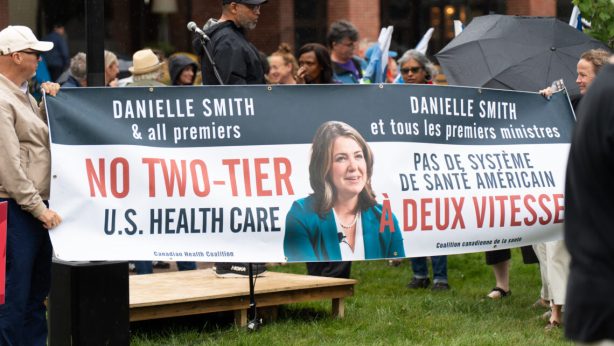
Alberta’s Bill 11 health care law violates Canada Health Act: legal experts
Legal experts in the health care field have completed a thorough examination of Alberta Premier Danielle Smith’s Bill 11 health care law and found it to be in clear violation of the federal Canada Health Act.
Bill 11 is, “the most extensive privatization of payment for medically necessary services in Canada since the Canada Health Act was enacted in 1984,” writes Emma Phillips of Goldblatt Partners LLP.
“The Canada Health Act embodies the fundamental value that medical services should be allocated on the basis of need, not ability to pay,” she writes. “Facilitating a two-tier regime introducing private payment for medically required services which in turn can lead to preferential access is directly contrary to the core requirements, criteria and principles of the Canada Health Act.”
On December 18, 2025, Alberta enacted the Health Statutes Amendment Act, 2025 (No. 2), also known as ‘Bill 11’. Bill 11 amends the Alberta Heath Care Insurance Act by establishing the legal framework for physicians to engage in dual practice.
The result is some patients will be able to access medically necessary services more quickly based solely on their ability to pay. By entrenching “queue-jumping”, Bill 11 contravenes the principles of comprehensiveness, accessibility, and universality protected and required by the Canada Health Act and violates the prohibitions against extra-billing and user fees, according to the legal experts.
“The federal government is balancing diplomatic engagement with Alberta against the need to enforce CHA principles firmly,” said Jason MacLean, chairperson of the Canadian health Coalition which commissioned Goldblatt Partners LLP to conduct the review.
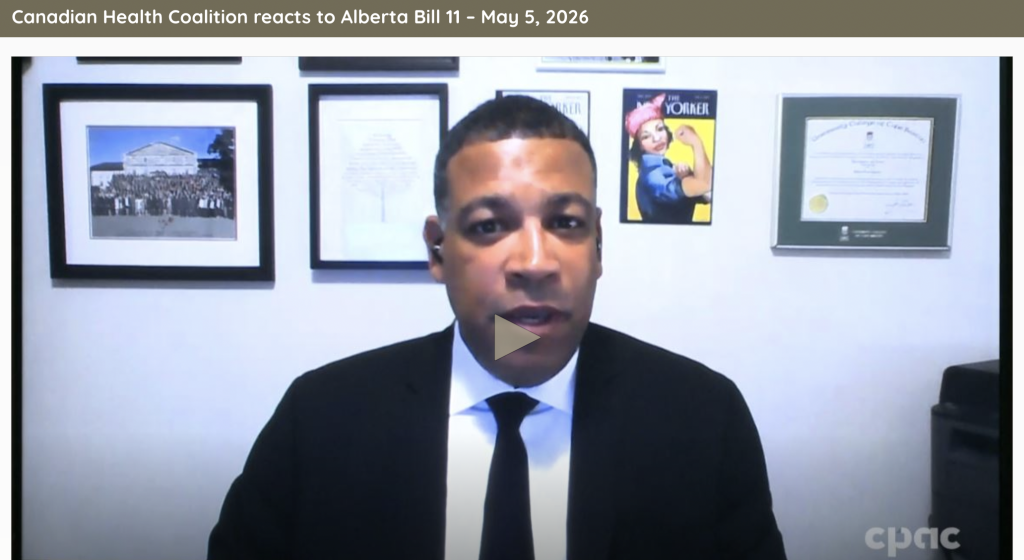
On May 5, the Canadian Health Coalition reacted to the passing of Alberta’s Bill 11 at a media conference on Parliament Hill. Speaking at the media conference was lawyer Emma Phillips, along with Jason MacLean, Canadian Health Coalition, Chris Gallaway, Alberta’s Friends of Medicare, and Dr. Melanie Bechard, Canadian Doctors for Medicare. Watch the media conference here.
“Health Minister Marjorie Michel often says she is the ‘Guardian of the Canada Health Act,’” said MacLean. “The Minister needs to clarify that it is the federal government’s position that Alberta’s Bill 11 violates the Canada Health Act, and she is prepared to enforce the Act.”
The Province of Alberta could be jeopardizing over $7 billion through the Canada Health Transfer in 2026-2027. The Canada Health Act empowers federal government to withhold transfers should the province fail to comply with the Act.
SUMMARY OF LEGAL OPINION ON BILL 11
There is a strong and compelling basis for concluding that Alberta’s Bill 11, by authorizing physicians to provide medically necessary services through a dual-practice model (publicly insured or privately paid on a service-by-service basis), contravene the Canada Health Act’s core prohibitions against extra-billing and user charges, and its requirements that a provincial health care system be comprehensive, universal and accessible.
What Bill 11 Does
Bill 11 creates the most extensive privatization of payment for medically required physician services since the Canada Health Act’s enactment in 1984, enabling a new category of “flexibly participating” physicians to provide medically necessary services either through the publicly funded system or for private payment on a service-by-service basis.
That structure, in substance, permits queue-jumping and creates a parallel private pathway for the provisions of medically necessary care to insured residents of Alberta, contrary to the core objectives and provisions of the Canada Health, including universality, accessibility, comprehensiveness, and prohibitions on extra-billing/user charges.
Bill 11 Violates Canada Health Act Requirements
The CHA’s purpose is to protect, promote, and restore health and to facilitate reasonable access to health services without financial or other barriers. To that end, the CHA conditions federal transfer funding on provincial plans meeting five criteria: public administration, comprehensiveness, universality, portability, and accessibility. The CHA also prohibits extra-billing and user charges for insured services. The core principle animating the Act is straightforward: medically necessary care must be available on the basis of need, not ability to pay.
Universality criterion (s. 10): The universality criterion requires that 100 percent of insured residents have access to insured health services on uniform terms and conditions. However, Bill 11 undermines this by enabling a dual track of access: all Albertans remain technically insured, but those able to pay can purchase faster access to the very same medically required services from the same physicians, while others must wait in the public queue. Two patients with identical medical needs but different ability to pay will now face systematically different conditions of access—one has the option of more timely, privately delivered care, the other does not—so that access is no longer provided on uniform terms and conditions.
Accessibility criterion (s. 12): The accessibility criterion requires that insured persons have reasonable access to insured services without direct or indirect financial barriers. However, by authorizing physicians to sell privately paid, non‑Plan versions of medically required services, Bill 11 erects a direct financial barrier to timely care for those who cannot pay. For many procedures, timely access will, as a practical matter, be available only to those who can afford private pay fees, while others are left with longer waits in the publicly funded system. At the same time, dual practice is expected to shift physician time and operating capacity toward the more lucrative private pay stream, thereby degrading capacity and lengthening wait times in the publicly funded tier. Both the private pay charges (whether out-of-pocket or through private duplicative insurance) and the foreseeable resource shift constitute the very kind of direct and indirect barriers to reasonable access that the accessibility criterion is designed to prevent.
Comprehensiveness Criterion (s. 9): Under the comprehensiveness criterion, provincial plans must insure all medically required physician services. However, Bill 11 allows services that Alberta itself treats as medically required to be sold privately as
“non‑Plan” services by flexibly participating physicians, rather than being uniformly covered by the public plan. In effect, some medically necessary services are removed from the scope of public insurance whenever a flexibly participating physician elects to bill privately, so the plan can no longer be said to comprehensively insure all medically required services provided by that physician.
Extra-billing and User-charges (s. 18, s. 19): Finally, the Canada Health Act’s prohibitions on extra‑billing and user charges bar physicians from charging insured patients any amount in respect of an insured (medically necessary) service beyond what is paid by the public plan. Bill 11, however, permits flexibly participating physicians who remain enrolled in the public plan to charge patients privately for medically required services that are identical in substance to medically required publicly funded services. When a flexibly enrolled physician bills a patient instead of the public plan for a hip replacement, that payment functions either as extra‑billing (where it is an amount in addition to what the plan would pay for that medically required service) or as a user charge (where the province authorizes or permits the patient to pay for a medically required service that would otherwise be covered by the plan). Allowing Alberta to re‑label these insured, medically necessary, services as “non‑Plan” services when provided by a flexibly participating physician does not change their status under the Canada Health Act as medically required services for which extra-billing or user fees are not permitted and, if accepted, would render the Act’s protections meaningless.
Federal Government CHA Interpretation Letters Supports Conclusion that Bill 11 Violates the Canada Health Act
Since 1985, federal Ministers of Health have repeatedly taken the position that point-of-service charges, private pay fees for medically required insured services, and dual practice are inconsistent with the Act’s objectives. This includes the 2005 interpretation letter addressing dual practice which stated that allowing physicians to practise in both the public pay and private pay systems creates a serious risk of undermining access, encourages queue-jumping, and is inconsistent with the accessibility criterion of the Act. Other subsequent interpretation letters reinforced the same principle by confirming that medically necessary services must remain insured even when delivered in privately owned settings, and that charges to patients for such services are not permitted. Notably, the courts have recognized that these federal government interpretation letters are relevant to the interpretation and application of the Canada Health Act.
Cambie Litigation Findings and Federal Government Position in Cambie Confirm Bill Violates CHA
In the B.C. litigation (Cambie Surgeries Corporation v. British Columbia), British Columbia courts reviewed extensive evidence showing that dual practice and duplicative private financing can worsen wait times, divert providers away from the publicly funded system, and create incentives for physicians to prioritize private pay patients. These findings lend unequivocal support to the conclusion that, by its very design, Bill 11 will have significantly adverse consequences for equity, access, and the sustainability of the public system. In short, the findings in the Cambie litigation support the conclusion that, by normalizing a private-pay lane for otherwise publicly insured medically required care, Bill 11 encourages and permits queue-jumping, widens inequities between patients who can and cannot afford to pay, and weakens the publicly funded system by drawing resources into the private pay market.
Notably, the federal government actively intervened in the Cambie litigation to defend British Columbia’s restrictions on dual practice, extra‑billing, and private duplicative insurance, explicitly on the grounds that removing those restrictions would put the province off‑side the CHA’s extra‑billing and user‑charge provisions and threaten accessibility/universality. Indeed, when the BC Court of Appeal’s decision was released, the Minister of Health released a public statement emphasizing that “the federal government joined the proceedings as a party to support BC in its defence of its legislation, a mirror of the fundamental principles of the CHA, which values equity and fairness over profit and preferential access to required care” and that “any Canadian who requires medically necessary care should be able to receive it based on medical need and not on the ability or willingness to pay. Patient charges—whether they take the form of charges at the point of service or payment for private insurance—undermine equity.”
In addition, the Alberta Court of Appeal’s 2015 decision in Allen also recognizing that dual practice and private insurance for medically required services is inconsistent with governing principles of the Canada Health Act.
Conclusion
By facilitating a two-tier public and private payment regime that permits physicians to provide the same medically required services through either public or private payment, and by introducing private payment for preferential access to physician services, Bill 11 contravenes the core principles and protections of the Canada Health Act. Indeed, based on its own public interpretations and commitments in the Ministerial “interpretation letters” and before the courts in Cambie, the federal government has already articulated precisely why Bill 11 contravenes the Canada Health Act. As the federal government argued in Cambie, “from a federal perspective, when enrolled physicians charge insured residents for insured services, this is in contravention of the extra-billing and user charge provisions of the Canada Health Act” and the “goal of equitable access” to medically necessary health services would be significantly compromised.