Two good reasons to oppose unconditional health care money for provinces
This commentary by Canadian Health Coalition Chairperson Pauline Worsfold and Vice-Chairperson Siobhán Vipond appeared in the Toronto Star.
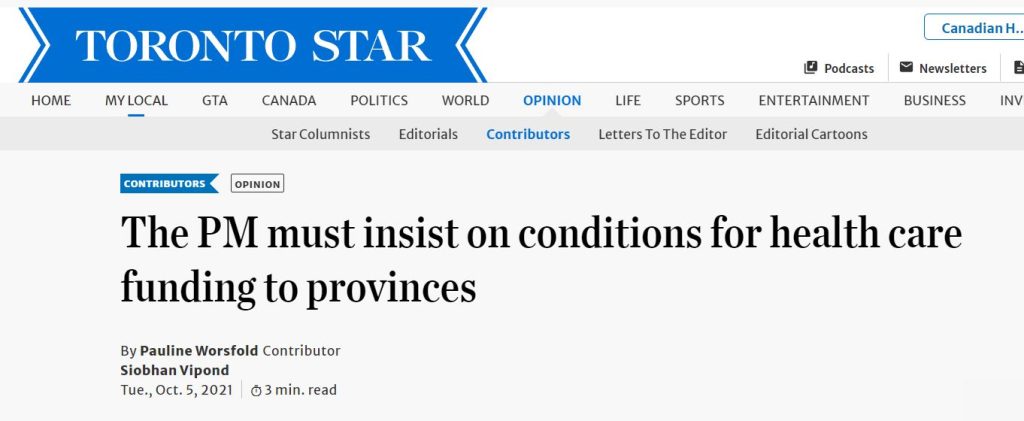
The PM must insist on conditions for health care funding to provinces
Tue., Oct. 5, 2021
Prime Minister Justin Trudeau has so far delayed talks with Canada’s provincial and territorial leaders on their repeated demands for significant, unconditional health care funding increases. The premiers want to start negotiations right away, but the prime minister prefers to get through the pandemic first, then talk funding later.
Our organizations support improving and expanding publicly delivered health care for Canadians. Moving forward together to a fair and resilient pandemic recovery means a much more considered and collaborative approach that puts people first.
At first glance, the premiers’ request seems reasonable. The pandemic is putting a strain on hospitals and health care workers, creating a health care crisis.
But Trudeau is correct to avoid what may amount to cutting a blank cheque to provinces if he cannot ensure that the money will deliver improvements to existing public health care and expanding public health care to much needed long-term care and universal pharmacare. That’s why the premiers’ demands deserve a closer look.
The Sept. 23 letter from the premiers sets out their criteria for the Canada Health Transfer. Federal funding must: be unconditional; increase from 22 to 35 per cent of total health care; and increase every year by 5 per cent.
We believe the prime minister has two good reasons to be very cautious about these demands.
First, the premiers’ singular insistence the Canada Health Transfer be unconditional doesn’t make sense when system improvements and new health care services are needed to truly strengthen public health care to protect Canadians
More money might not equal more health care services for Canadians. Unfortunately, Canada Health Transfer dollars are not required to be spent exclusively on health care. There is no accountability mechanism to track how the provinces spend this money either. Boosting the federal contribution from 22 to 35 per cent of total health care spending will cost an estimated $28 billion a year, but Canadians might not see even one dollar of additional or new health care services.
Suppose the federal government increases its percentage share of provincial health care costs. In that case, the provinces are free to reduce their spending by a corresponding percentage.
After the federal cheque is cashed, some premiers may spend the money as they like, including on tax cuts. For instance, in 2007, the Liberal government in Quebec used a $700-million federal bump in equalization payments to fund a pre-election middle-class income tax break.
Second, the premiers need to show their math for a five-per-cent increase, which is a significant rise from the current annual figure.
A 2016 study by the Canadian Institute for Health Information found that provinces had been boosting health care spending by only 2.7 per cent annually between 2011 and 2015, while pocketing a six-per-cent annual increase from the Harper government. The Trudeau government adjusted the growth to equal the three-year moving average of Canada’s nominal GDP, but not less than three per cent per year. Nominal GDP measures a country’s economic output with inflation.
If the prime minister gives in to premiers’ demands for billions with no strings attached now, there may be little money left to fund new health care programs later.
The Liberals made some big health care commitments during the election. They promised to hire 7,500 nurses and family doctors, increase wages and train 50,000 new personal support workers, boost long-term care funding by $9-billion and enforce national standards through a new Safe Long-Term Care Act, and curtail rising drug costs.
Instead of rushing to hold negotiations this fall, as the premiers asked, Trudeau should put forward proposals of his own, starting with his long-promised pharmacare program, potentially bundled with any Canada Health Transfer increases. A single-payer public drug plan is supported by 86 per cent of Canadians according to the Angus Reid Institute, is backed by the NDP, and would save billions of dollars for employers, families, and especially the provinces.

Pauline Worsfold 
Siobhán Vipond
Pauline Worsfold, RN, is chairperson of the Canadian Health Coalition and Siobhán Vipond is executive vice-president of the Canadian Labour Congress.
This article was published in the Toronto Star on October 5, 2021.