
The story of Nell Toussaint: Challenging Canada’s violation of the human right to health care
Among health equity advocates in Canada, Nell Toussaint is a familiar name. A groundbreaking human rights defender who challenged Canada’s denial of health care access to non-status workers, Nell is an inspiration and a role model.
Nell’s efforts to challenge this denial in Canadian courts began in 2010. Sixteen years later, through multiple court proceedings, a challenge to the UN Human Rights Committee, continuous denial of rights by Canada, and Nell’s unfortunate passing, health care advocates’ calls for change are still left unanswered.
Background information
Born in Grenada, Nell Toussaint came to Canada in 1999 on a visitor visa. After it expired, she stayed in the country as a non-status migrant and continuously tried to regularize her resident status. While living in Canada, Nell worked and her employers made deductions from her salary to cover federal and provincial taxes, the Canadian Pension Plan, and Employment Insurance. Given her irregular status, she could not receive these benefits as someone with regular migration status in Canada could.
In 2006, Nell began experiencing chronic fatigue and her health continued to deteriorate. Within three years, she was diagnosed with diabetes and other chronic illnesses. The Canadian government denied her publicly funded medical care due to her irregular immigration status until 2013, when she finally became a permanent resident. Unfortunately, it was too late and she had already suffered “irreversible sickness” because of her delayed coverage.
Judicial Review proceedings and the groundbreaking UN Human Rights Committee decision
Between 2010 and 2011, Nell started judicial review proceedings challenging Canada’s refusal to provide her with health care coverage. The Federal Court dismissed her application.
In response, Nell brought the case before the United Nations Human Rights Committee. In 2018, the Committee concluded that Canada had violated her right to life and her equality rights. It directed Canada to provide compensation to Nell and allowed Canada 18 months to take steps so that other similarly situated migrants would have the right to health care.

Charter Claim – Motion to Strike
Using the precedent set by the Committee, Nell returned to the Canadian courts in 2020 to bring a Charter claim against the Attorney General of Canada for violating equality rights.
In her application, Nell sought a declaration that Canada’s failure to give effect to the views adopted by the Committee violated sections 7 and 15 of the Canadian Charter of Rights and Freedoms. She sought an order under s. 24(1) of the Charter requiring Canada to implement the views of the Committee. Finally, Nell pleaded that Canada is in violation of articles 6 and 26 of the International Covenant on Civil and Political Rights (ICCPR). She asserted that Canada has a duty to ensure that there is an effective remedy for its violations.
After Nell commenced proceedings, Canada brought a motion to strike (to cancel) the proceedings on the grounds that her case was doomed to fail. Justice Perell of the Ontario Superior Court of Justice dismissed Canada’s motion in 2022.
Current legal proceedings
Sadly, Nell Toussaint died in 2023. Following Justice Perell’s decision, the estate of Nell Toussaint, chiefly led by her mother Ann Toussaint, filed a motion to the Ontario Superior Court in 2024 to exempt the proceedings from mandatory mediation (a requirement of parties in civil lawsuits to attend mediation before proceeding to trial). The Toussaint estate argued that the action involves complex matters of public interest or importance, which requires adjudication in order to establish an authority which will be persuasive, if not binding, on other cases; thus, a trial is more appropriate.
The most recent decision in the Toussaint case came out on March 31, 2025, in which Justice Papageorgiou from the Ontario Superior Court of Justice allowed the Toussaint matter to be exempted from mandatory mediation. Additionally, the justice allowed different public interest groups like the Canadian Health Coalition, Amnesty International Canada, and others to intervene as “friends of the court.” An amicus curiae, or “friend of the court,” is a lawyer appointed by the court to hear arguments that otherwise might be overlooked by the parties. They are intended to be impartial, court-approved, and they present facts or law that otherwise could be excluded from the proceedings. Along with the Canadian Health Coalition, these parties will have access to documents produced in discovery and to attend cross-examinations of witnesses in relation to the documents.
Nell Toussaint died awaiting a decision that took three years to determine if she could even proceed with a legal argument.
We are now approaching the six year mark after Nell Toussaint began this legal proceeding. When quick action is essential, we can see the devastating effects of legal proceedings that take too much time.
In March 2026, the 145th session of the United Nations Human Rights Committee convened to review Canada’s compliance under the ICCPR. In February, the Social Rights Advocacy Centre (SRAC) and the International Network for Economic, Social and Cultural Rights (ESCR-Net) provided a joint submission for review, reporting violations of the ICCPR and highlighting systemic issues within the country. Unfortunately, while Canada affirms its commitment to ensure some rights of Temporary Foreign Workers to the Committee, the rights of non-status migrant workers and Nell Toussaint’s situation remains vague.
The Committee remains concerned about Canada’s lack of implementation of its international human rights obligations, including “the lack of full implementation of Toussaint v. Canada,” and its reluctance to give full effect to the Committee’s Views. Additionally, the Committee recommends structured federal, provincial, and territorial legal frameworks to guarantee an effective remedy to victims.
Other context
The legislative framework is changing, and not necessarily for the better. Canada is now severely restricting access to permanent residency on the basis of humanitarian and compassionate (H&C) grounds. As part of the Immigration Levels Plan, the total number of permanent residencies permitted on H&C grounds has decreased from 13,750 people in 2024 to projected 1,100 in 2026. New applicants go to the back of the line for H&C applications. Given the total number of current applications, new applicants could be waiting 50 years for their application to be reviewed.
Remembering Nell Toussaint
The story of Nell Toussaint is long, painful, and complex. Nell’s passing in 2023 was entirely preventable, should she have received care earlier. Despite all efforts, calls for change have been left unsatisfied.
Nell’s motto, “to fight for others and win,” is an inspiration for anyone fighting for universal health care. Her legal battle is encouraging, hopeful, and no doubt monumental.
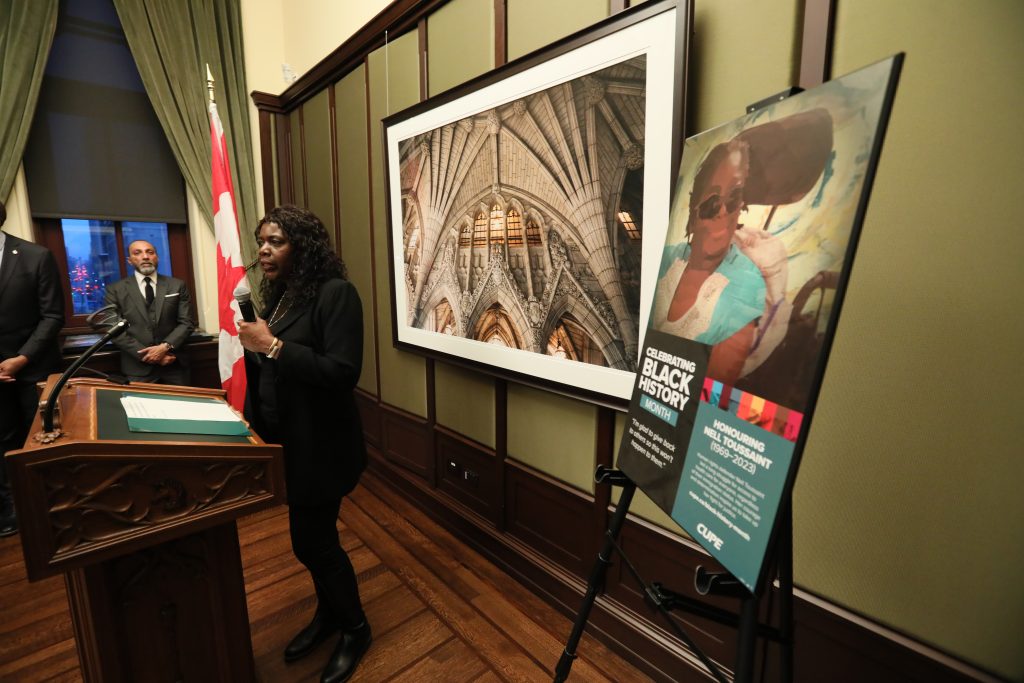
Recently added “friend of the court” to intervene in her case, the Canadian Health Coalition believes that health care is a fundamental right in Canada, without distinction of race, gender, age, religion, sexual orientation, political belief, immigration status, and economic or social condition. Nell Toussaint’s story is our reminder that there is lots of work to be done.
This resource does not contain legal advice. This resource was prepared with the assistance of PBSC uOttawa Common law student volunteers. PBSC volunteers are not lawyers and they are not authorized to provide legal advice. This resource contains general discussion of certain legal and related issues only. If you require legal advice, please consult with a lawyer.
Lisa Tran is a first year law student at the University of Ottawa who completed a Pro-Bono Student placement with the Canadian Health Coalition in 2025-2026.