
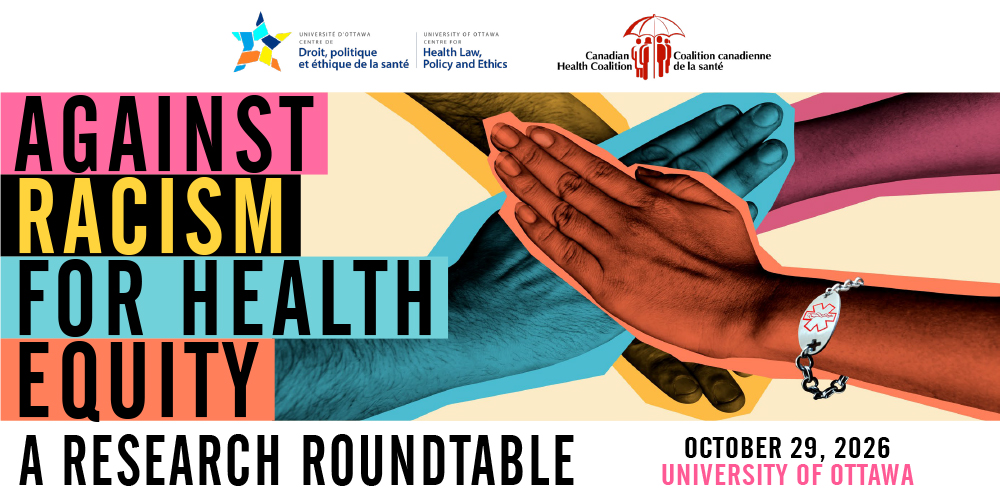
Against Racism, For Health Equity: A Research Roundtable
Registration is now open for the Against Racism, For Health Equity: A Research Roundtable by the Canadian Health Coalition and the University of Ottawa Centre for Health Law, Policy and Ethics.
Canada’s most eminent scholars, medical doctors and health practitioners will share their research on systemic racism in health care at a research roundtable at the University of Ottawa on October 29, 2026.
Keynote speakers are Jude Mary Cénat, Director of the Interdisciplinary Centre for Black Health at the University of Ottawa, and Dr. Bolu Ogunyemi, President of the Canadian Medical Association.
Deadline to register: Oct. 1, 2026.
Registration fee: $100 for full-time faculty and those with institutional/organizational support. $50 for contract faculty, those without institutional /organizational support. Limited participation subsidies are available for participants who need support.
Canada’s Medicare system is celebrated for being free and universal. The Canada Health Act is supposed to ensure residents have access to medically necessary hospital and physician services without financial barriers. The principle of anti-discrimination is guaranteed in human rights legislation across the country, in section 15 of the Canadian Charter, and in various international treaties. Yet, not every patient and health care worker is treated the same in Canada’s health care system.
This research roundtable will examine how racism affects people receiving health care and providing health care in Canada. It will also probe how racism affects people’s right to access health care in the country. While racial disparities have been documented in Canada’s health care system, inadequate attention has been paid to how systemic racism threatens promises of universal health coverage (Adejoke et al., 2025).
Academic, union and community-based researchers, students and others curious about systemic racism in health care will want to attend. The research roundtable will be an opportunity to share promising practices and build partnerships across diverse disciplines and backgrounds.
For more information, contact Tracy Glynn at tglynn@healthcoalition.ca.
The Canadian Health Coalition was founded in 1979 and comprises frontline health care workers’ unions, community groups, students, and public health experts. A strategic priority of the Canadian Health Coalition is ending systemic racism in health care.
The University of Ottawa Centre for Health Law, Policy and Ethics (CHLPE) is Canada’s largest, and a globally recognized, interdisciplinary hub for health research. Based in Ottawa, it brings together faculty and students from law, medicine, social sciences, and more to inform policy and legal strategies on health issues.