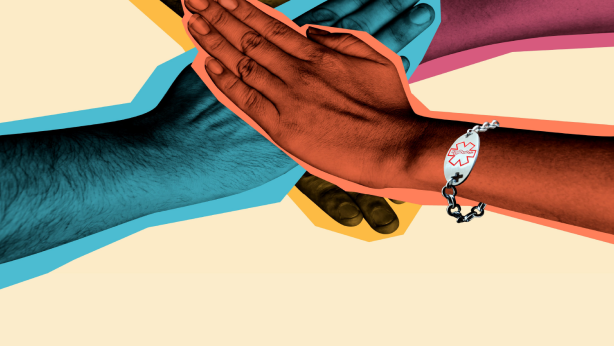
August 1 marks Emancipation Day
The Canadian Health Coalition seeks to eliminate systemic racism in health care. Frontline health care workers, particularly those from marginalized and racialized groups, must be included in efforts to eliminate systemic racism and other barriers to care.
On March 24, 2021, the House of Commons voted unanimously to officially designate August 1 as Emancipation Day. This day in 1834 marks when the Slavery Abolition Act of 1833 came into effect in the British Empire.
Our coalition also believes that access to health care in Canada is a fundamental right, regardless of race, gender, age, religion, sexual orientation, political belief, immigration status, and economic or social condition.
Many groups representing racialized people across Canada organize around the importance of fighting racism including the Alliance for Healthier Communities in Toronto. The Alliance calls on governments to recognize the impact of racism in the community and in the health care system by declaring that racism is a health crisis.
According to a paper in Le Devoir, it is incumbent upon the Quebec government to address all forms of discrimination, including that which occurs in the health care system. The death of Joyce Echaquan, 37, an Attakamekw woman, on September 28 at the Centre hospitalier de Lanaudière in Saint-Charles-Borromée, strapped to her gurney, under a hail of racist insults, occurred one year after the tabling of the report of the Commission of Inquiry into relations between Indigenous people and certain public services in Québec. The Report was entitled “Listening, Reconciliation and Progress (CERP),” also known as the Viens Commission.
According to a paper by anthropologist Marie-Pierre Renaud, it would have been possible to require, as early as the fall of 2019, that health professionals, staff and managers of the administrative bodies that run the health care system in Québec, the CISSS and CIUSSS, take anti-racism training aimed at highlighting and reducing prejudice and denigrating attitudes towards Indigenous people.
According to Coroner Géhane Kamel, Eschaquan would still be alive if she were white.
Systemic racism in the health care system is found across Canada, as highlighted in this Canadian Medical Association Journal paper: Blacks represent 3.5% of the total population of Canada, and approximately 43% of Blacks in Canada were born in Canada.
In Nova Scotia, there are significant racialized communities, including descendants of people who were enslaved in Canada. Although slavery was abolished in 1831 in what was to become Canada, it was a fundamental institution in nation-building. Black Canadians also represent diverse immigrant communities.
In his book “Deux siècles d’esclavage au Québec”, Marcel Trudel, a Quebec historian, estimates that between 1671 and 1831 there were nearly 4,200 enslaved people in the region of Canada known as New France, and later, Upper and Lower Canada. Initially, about two-thirds of these enslaved people were Indigenous, and one-third were of African descent.
Canadians and Quebecers are not always aware that Black and Indigenous people were enslaved in what is now Canada. Those who fought against slavery played an essential role in shaping our society to be as diverse as it is today.
There is ample reason that on August 1 of each year, Canadians and Quebecers are invited to reflect on the history of the city and its inhabitants. They are also invited to learn and engage in the ongoing struggle against racism and discrimination against Black people.
Historian Marcel Trudel has counted 4,092 enslaved people throughout Canadian history, of which 2,692 were Indigenous and enslaved by the Francophones, and 1,400 were Blacks, enslaved by the Anglophones. Slave owners numbered at 1,400. The Montreal region dominated with 2,077 enslaved people, compared to 1,059 for Quebec City, and 114 for Trois-Rivières.
Emancipation Day celebrates the strength and perseverance of Black communities in Canada.
“We encourage our members to learn more about the struggles of Black and Indigenous people in Canada,” said Bert Blundon, President of the National Union of Public and General Employees (NUPGE) and member of the Canadian Health Coalition.
“Although slavery has been abolished, anti-black racism still exists in our country. We hope that Emancipation Day will serve as a catalyst for more people to join the ongoing fight against anti-black and Aboriginal racism and discrimination.”
The National Union of Public and General Employees (NUPGE)
The National Union of Public and General Employees (NUPGE) is one of Canada’s largest labour organizations, with over 400,000 members. Their mission is to improve the lives of working families and build a stronger Canada by ensuring that our common wealth is used for the common good.
While their Components are located from coast to coast to coast, the National Union of Public and General Employees office is located on the unceded traditional territory of the Algonquin Anishinaabeg people.
Suggested reading:
A brief history of slavery in Canada.
Why we should welcome the teaching of critical race theory.